Your Google Listing Isn't Expired. It Just Looks Abandoned.
Google never published a 30-day expiration date for Business Profiles. Local shops still lose ground when the listing goes quiet. Here's a monthly habit that keeps Maps from treating you like a ghost town.


You set up the Google Business Profile once. Hours, categories, a hero shot of the van, maybe a services list somebody copied from the website in 2023. Then real work started, and the listing sat there like a dusty lobby plant.
Lately the calls feel softer. Maps feels quieter. Nothing "broke." You just stopped feeding the thing Google and customers both treat as proof you're still open for business.
This is not another sermon about review velocity alone. That piece already exists. This is the shorter habit: keep the profile itself from looking abandoned.
Google did not print an expiration date
A wave of local SEO shops and trackers have been saying the same thing through 2026: profiles that go roughly a month with no owner activity start losing Maps and local-pack visibility. LinkNow Media summarized the pattern plainly this month. Google has not published a 30-day penalty. Treat the report as a field observation, not a Terms of Service clause.
You do not need a conspiracy theory. You need a reason the pattern keeps showing up. Google's own help still says local results lean on relevance, distance, and prominence, and that complete, accurate Business Profile info helps you show up. Quiet profiles give the algorithm and the customer less fresh evidence that you are still the right match.
Whitespark's 2026 Local Search Ranking Factors survey (47 practitioners scoring hundreds of signals) puts Google Business Profile signals at about 32% of local pack and Maps influence. That is the biggest group in the pack. Reviews are a separate pile. Owner activity and customer reviews are not the same chore.
Customers already vote with the calendar
BrightLocal's 2026 Local Consumer Review Survey (1,002 US consumers) found that 74% look for reviews written in the last three months. Thirty-two percent want something from the last two weeks. Eighteen percent only care about the last week.
So the five-star from 2022 still looks nice in a screenshot. It does not do the same work as three specific reviews from last month when someone is comparing you to the shop down the road.
Shop-floor tell: if your newest review is older than the leftover holiday candy in the break room, the listing already feels like a museum exhibit.
What "activity" actually means
Activity is not "open the app and stare." It is a short list of owner moves Google and customers can see:
- Fresh job photos (before/after, van on site, finished install — not stock loft living rooms)
- A Google post when something real changed (seasonal offer, new service, holiday hours)
- Hours, services, and attributes that still match the shop this week
- Replies to new reviews, including the awkward ones
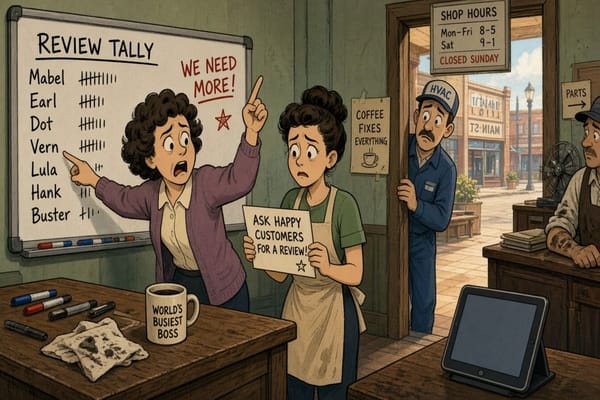
- A clean ask for a review after finished work (no discount, no "leave five stars and win")
Reviews help. They are not a substitute for the rest. A trickle of five-stars on a profile whose last photo is from two summers ago still reads as half-alive. The customer wrote lately. You did not.
The 30-day playbook (steal this)
Run this once a month. Put it on the same calendar reminder as payroll, or it will lose to the next emergency call.
Week 1: Truth-check the basics (15 minutes)
Open the profile on your phone the way a stranger would. Check primary category, additional categories, service areas or address, phone, website, and hours — including the "special hours" nobody updated after Memorial Day. If you are a service-area business, confirm the address is hidden the way you intend. Wrong hours are not a cute quirk. Whitespark's survey put "open at the time of search" high among pack signals for a reason.
Fix anything that would make a dispatcher hang up.
Week 2: Upload real photos (10 minutes)
Add 3–8 photos from actual jobs this month. Name the work in the caption if the app lets you. Mix trades across the gallery over time so you do not look like one service only. Skip the stock handshake. Customers can smell a catalog shot from the driveway.
Week 3: One useful post (10 minutes)
Write one Google post that a real customer might need: storm prep, filter-change reminders, new financing, Saturday hours, "we're booking water heater installs into next week." Link to a page that loads. Then leave it alone. Daily posts that say "Happy Monday!!!" are wallpaper.
Week 4: Reviews and replies (20 minutes)
Reply to every open review from the last month. Specific beats cute. Name the service when you can. For new work, ask finished customers the plain, Google-safe way — same ask you would put on a care card or after-photo text, not a raffle tied to a star rating. If you use a tool like More Good Reviews to send the ask after the job, fine. The habit matters more than the software logo.
That is the whole month. Four short blocks. No agency deck required.
If you already went quiet
Start this week. Do not dump thirty stock photos in one night and vanish again. The reported pattern is about ongoing evidence, not a permanent scarlet letter. Resume the monthly loop: accurate info, real photos, one useful post, review replies, steady asks.
While you are in there, skim the last year of reviews for themes. Google's AI review summary and Ask Maps answers lean on what customers keep saying. Fresh, specific reviews are the feedstock. Empty marketing adjectives are not.
What not to do
- Do not keyword-stuff the business name. Google's guidelines still hate that, and suspension risk is a worse problem than a soft month.
- Do not buy reviews or run "leave a review to enter" contests. That is a different post, and a different kind of mess.
- Do not confuse a one-time GBP "audit" PDF with a habit. Audits expire. Monthly owner activity does not.
The bottom line
Google never stamped an expiration date on your Business Profile. Customers and ranking surveys still punish silence. Treat the listing like a shop window you wipe once a month: correct the hours, add real photos, post something useful, answer the reviews, and keep asking finished customers the clean way. A perfect setup from three years ago is a nice memory. A living profile is what Maps and AI answers can actually use.