Stop Counting Reviews on the Staff Whiteboard
Google's Maps contribution policy already bans review quotas, on-site pressure, and scripted review content. Use this shop-floor audit to fix the whiteboard, tablet, and talk track without killing honest asks.

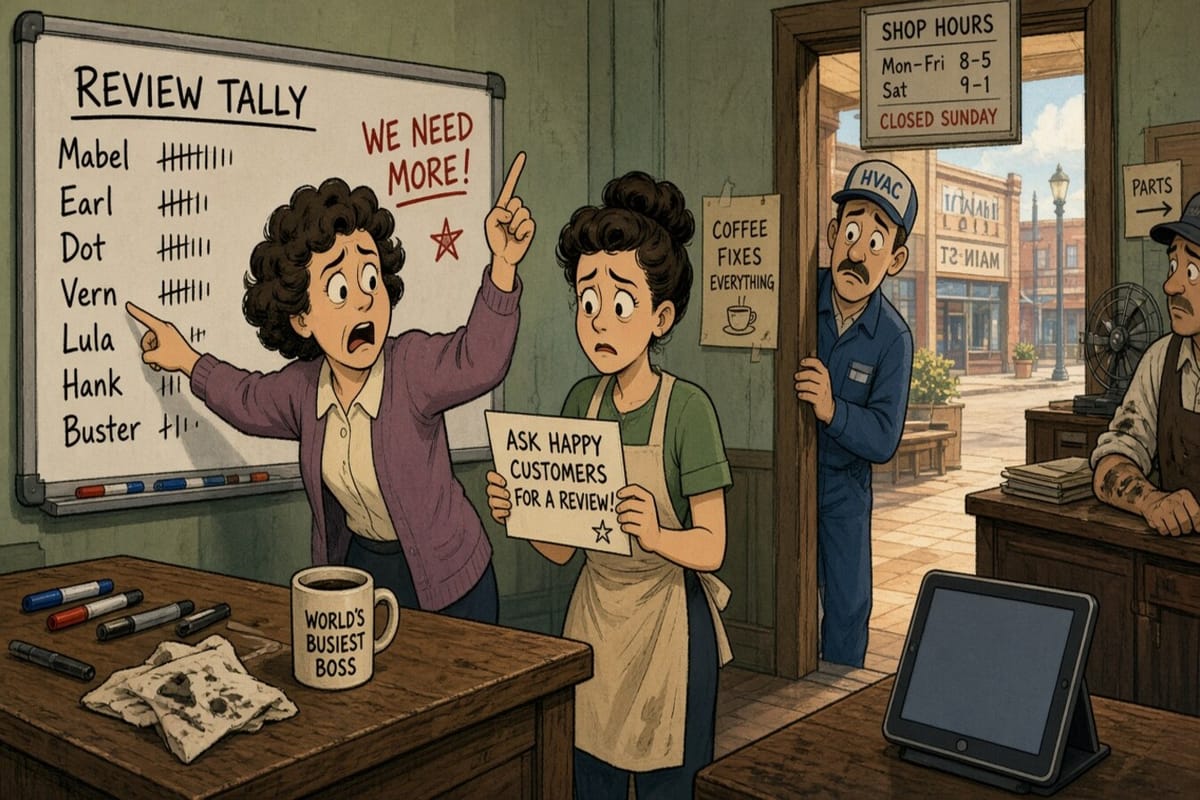
Walk into enough back offices and you'll see the same marker board: "Google reviews this week — Mike 2, Dana 1, front desk 0." Someone circled Friday in red. Someone else taped a QR code under the tablet in the lobby with a sticky note that says "mention the tech." It feels like hustle. Google's Maps contribution policy calls a big chunk of it rating manipulation.
This isn't a lecture about never asking. Google still wants you to invite real customers to leave honest feedback. The problem is how a lot of shops run the ask on the floor — quotas, scripts, and pressure that don't match what merchants are allowed to do. Use this as a quick audit of your review workflow, not another motivational poster for the break room.
What Google already told merchants
Google's Maps User Generated Content / contribution policy is blunt under Rating Manipulation. When soliciting reviews, merchants should not:
- Require or pressure users to leave ratings or write reviews while on the premises
- Request that specific content be included in a review
- Ask staff to solicit a certain number of reviews
- Ask staff to solicit reviews that include specific content, including content that identifies a staff member
Two other bans you already know (and shouldn't rebuild under a new name): incentives tied to reviews, and selectively soliciting only positive reviews — review gating. This post isn't a deep dive on gift cards or "only if you loved it" filters. It's about the shop-floor habits that still show up next to the whiteboard.
What is still fine? Google's own Tips to get more reviews still says you can remind customers to leave reviews — for example with a Google review link or QR code — reply to what you get, and treat a mix of feedback as normal. Genuine experience, no incentives, no steering the stars or the wording.
Shop-floor audit: do this, not that
Run these checks like you'd walk the space before open. If something fails, fix the process — don't just erase the board and hope nobody notices.
1. Staff scoreboards and review quotas
Not that: "Get 5 Google reviews this week" as a KPI, contest, or write-up risk. Tally marks by name. Spiffs for whoever "closes" the most reviews. Manager stand-ups that treat review count like units sold.
Do this: Measure what staff actually control — service quality, how often they send a neutral ask after a completed job, how fast they escalate a complaint. Celebrate good work internally. Don't assign a number of public Google reviews to a human.
If the only way your team "wins" Friday is a star count on Maps, you've built the exact quota Google says merchants shouldn't request from staff.
2. Lobby tablets and "leave it before you leave" pressure
Not that: Handing someone a tablet at the counter while they wait for the receipt. Hovering while they type. Blocking the door vibe — "quick review real quick before you go." Same energy as a dentist chair ask while the bib is still on: the customer isn't free to walk away and decide later.
Do this: Make the ask easy and optional after the visit. Text or email a clean Google review link once they're home. Leave a card or QR they can use on their own phone, on their own time. Reminding is allowed. Requiring or pressuring them on-premises is the line Google drew.
If your process only "works" when someone is still in your chair, waiting room, or bay, rewrite the timing before you rewrite the copy.
3. Scripts that coach the review text
Not that: "Please mention Mike," "say we were on time," "talk about our warranty," "use these three words." Cue cards. Suggested bullet points for Google. Anything that tells the customer what content to include.
Do this: Keep the ask boring on purpose: thanks for coming in — if you're willing, here's where people leave Google reviews. No star target. No talking points. Their words, their experience.
Naming a staff member in the ask is also out under the same policy. If you need internal credit for who did the job, handle that in your own systems — scheduling notes, CRM tags, private scorecards — not by coaching what should appear on Google. A neutral ask plus internal credit beats a "mention Dana" script every time.
4. Contests that look like hustle but smell like quotas
Not that: Pizza Friday for the location that hits 20 new reviews. Employee of the month based on review volume. "Race to 4.9" posters in the break room.
Do this: If you want team goals, aim them at training, response times, follow-up completion, or complaint recovery — outcomes you can supervise without buying a rating spike. Public review volume is a lagging signal, not a fair personal target.
The marker board doesn't get smarter because you swapped "reviews" for "5-star reviews." That's still a quota with a smiley face.
5. Selective asks dressed up as "good timing"
Not that: Only texting happy faces. Only asking after you already know they're thrilled. Training the desk to skip anyone who frowned in the lobby. (That's gating — briefly: don't rebuild it.)
Do this: Use a consistent, post-service ask for customers you're allowed to contact — not a vibe check that filters for praise. Happy and unhappy people both leave useful signal. Your replies do more brand work than a scrubbed feed.
6. "Helpful" prompts that still request specific content
Not that: Follow-up emails with "Tell them about our same-day service and friendly techs." SMS templates with fill-in-the-blank praise. Signage that lists what a "good review" should cover.
Do this: One link. One short thank-you. Zero content coaching. If you want better reviews over time, improve the visit — don't improve the customer's homework assignment.
A 10-minute whiteboard replacement checklist
Print this, walk the floor, check boxes. Fix whatever fails before the next staff meeting.
- Erase review quotas by person. No weekly review targets tied to individuals or shifts.
- Kill content scripts. No "mention [name]," no required topics, no suggested star rating in the ask.
- Move the ask off the premises pressure. Prefer after-visit link or QR on their device; don't require typing while they're still in your space.
- Separate praise from process. Thank great staff in private or in team meetings; don't make Google the scoreboard.
- Standardize the invite. Same neutral reminder for eligible customers — not only the ones who already smiled.
- Train the phrase, not the paragraph. Staff can say: "If you ever want to leave a Google review, here's how" — then stop talking.
- Audit signage and tablets. Anything that pressures an on-site review or dictates wording comes down.
- Keep incentives and gating out of the rebuild. No "review to enter," no "only if you'd give us 5." Those fights are settled; don't reopen them with new packaging.
- Watch patterns, not people. Track overall review health and response habits. Don't crown a "review champion" based on Maps volume.
- Document the new rule once. One page in the handbook beats a sticky note that drifts back to "get five by Friday."
What still works (and won't get you side-eyed)
You don't need a gimmick. You need a boring, repeatable invite:
- Send a direct Google review link or QR after the job, appointment, or pickup
- Ask once, politely, without a bribe and without a script for their wording
- Reply to reviews like a grown-up runs the place
- Fix the experience that creates the review in the first place
That's the lane Google's tips page still points to. The whiteboard was never the strategy — it was a shortcut that quietly crossed into staff quotas and coached content.
If your team needs credit for great work, give it where you control the rules: schedules, bonuses tied to service metrics you define, internal shout-outs. Leave Google for the customer's unscripted take.
The bottom line.
Asking for reviews is still allowed. Assigning review quotas, pressuring people on-site, and scripting what they should write — including naming staff — is not. Audit the board, the tablet, and the talk track this week. Keep the remind. Drop the scoreboard.