Google Will Draft Your Review Reply. Don't Hit Publish Blind.
Google drafts GBP review replies you can edit. Treat every AI reply as unfinished until a human checks it—especially on negatives.

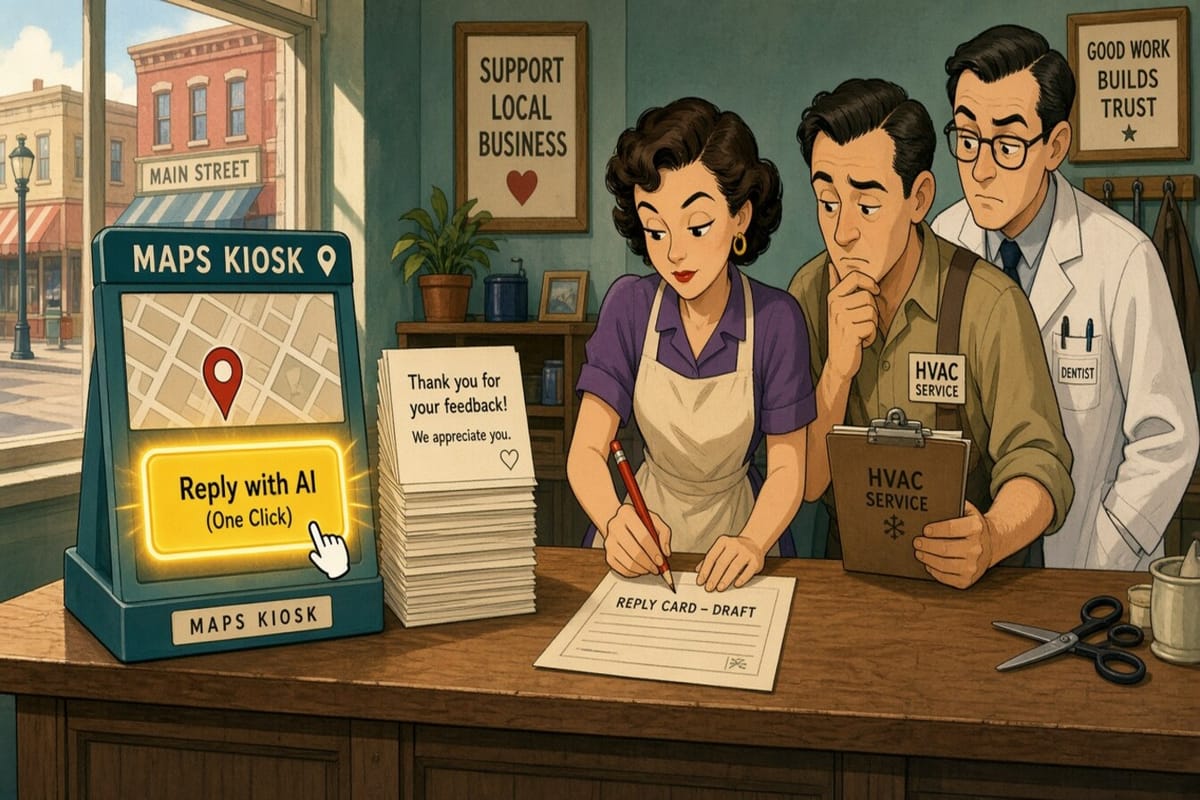
A new button shows up in your Google Business Profile: Reply to reviews with AI. One click, and Google drafts something polite enough to clear a backlog that has been staring at you since last summer. The HVAC truck is late, the salon chairs are full, the dental lobby is buzzing — and that draft looks finished.
It is not. Treat it like a first pass from a well-meaning intern who has never met your customer.
What Google is actually testing
In March 2026, Danny Goodwin at Search Engine Land reported Google testing AI-generated review replies inside Google Business Profile. The flow is draft → edit → submit. You can review the suggested reply, change it, and post it yourself. Early sightings showed up in the U.S., Brazil, and India, with availability that jumps around by account and even by review.
Barry Schwartz at Search Engine Roundtable described the same option a few days later: “Reply to reviews with AI,” pitched as a way to create personalized replies that build trust. Testers said the feature sometimes steered them toward older one-star reviews first — and then vanished when they tried the next unanswered review.
Reports conflict on bulk behavior. Some accounts can generate replies in batches. Some still need a human to approve each one. Others claim replies can publish with less oversight. Google has not published a clean “here is exactly how automation works” page for every shop. Until that exists, the safe operating rule is simple: no AI draft ships without a human reading the review and the reply together.
That is different from having better reply language ready. Scripts help when you write. This feature drafts for you. The risk is hitting Publish because the sentences sound professional, not because they sound like your shop.
Do this, not that
Do edit for this job. Don’t paste the generic thank-you.
Google’s own tips for review replies push personalization: name the specific feedback, skip the identical “thanks!” on every five-star. BrightLocal’s 2026 Local Consumer Review Survey found that templated or generic responses make 50% of consumers unlikely to choose a business. Half. That is not a rounding error — that is a closed shop door with a smile painted on it.
Do this: Pull one detail from the review — the Saturday attic unit, the color they asked for, the wait after school pickup — and put it in the first two sentences.
Not that: Leave the AI’s “We value your patronage and look forward to serving you again” alone. Nobody who sat in your waiting room talks like that.
Do own the fix on 1–2 star reviews. Don’t hide behind corporate armor.
Early tests often pointed people at older negative reviews. That is exactly where blind publish hurts most. A defensive “We’re sorry you feel that way” reads like a hotel chain. A vague “We apologize for any inconvenience” sounds like you never looked at the ticket.
Do this: Acknowledge the concrete problem, say what you can fix or already fixed, and invite them offline (phone or email) without dumping private details in public. Google’s reply guidance says the same: empathy, honesty about limits, no street fight in the comments.
Not that: Let the AI argue, minimize, or invent a resolution you never offered. If the draft claims you “already refunded the visit” and you did not, you just published fiction under your business name.
Do reply in your shop’s voice. Don’t let every review share one AI cadence.
Open five AI drafts side by side and you will spot the pattern: balanced clauses, soft adjectives, the same warm closing. Fine for a press release. Weird when your electrician, your esthetician, and your orthodontist all suddenly sound like the same customer-success bot.
Do this: Keep the sentences short if your shop talks short. Use the words your front desk actually uses. Sign with a real name or initials when that is your habit.
Not that: Approve a wall of near-identical paragraphs. Regulars notice. So do people comparing you to the salon two doors down.
Do clear the backlog deliberately. Don’t fire-and-forget bulk auto-publish.
BrightLocal’s 2026 survey also found that 89% of consumers expect owners to respond to reviews, and 80% say they’re more likely to use a business that responds to every review. Speed matters — 19% now expect a same-day reply — but speed without reading is how you congratulate someone for a job you botched.
Do this: Batch the easy five-stars with a light edit. Put awkward and negative reviews in a separate pile that gets a full human pass. If bulk generate exists on your account, treat it as a draft queue, not a publish button.
Not that: Assume “bulk” means “done.” Conflicting reports on whether every reply still needs approval are a feature, not a footnote. Until Google is explicit for your account, assume you are on the hook for every word that posts.
Do use AI as a first draft on quiet days. Don’t replace your reply habit.
The useful version of this test is a drafting aid when the phone finally stops. The dangerous version is “we don’t reply anymore — Google handles it.”
Do this: Keep the habit of checking reviews on a fixed cadence. Use the AI draft when it saves typing. Keep a short human checklist before Publish (below).
Not that: Turn off alerts and trust the button. Reply quality still beats reply volume theater. A fast, empty answer is still empty.
A 60-second edit checklist before you hit Publish
- Read the review again. What did they actually complain about or praise?
- Find one specific. Job detail, date, service, or staff moment that proves you read it.
- Fact-check the draft. No invented refunds, apologies for the wrong issue, or promises you cannot keep.
- Strip the corporate fog. Cut “valued patron,” “rest assured,” and twin closings that appear on every reply.
- Match the temperature. Five-star joy gets gratitude. One-star frustration gets ownership and an offline path — not a pep talk.
- Privacy check. No phone numbers, addresses, medical details, or naming-and-shaming in public.
- Say it out loud. If it sounds like a stranger wrote it, rewrite the opening line in your voice.
Sixty seconds is enough for most five-stars. Negatives deserve longer. That is the point of having a human in the loop.
The bottom line
Google’s “Reply to reviews with AI” test can draft a polite response in seconds. Spotted in March 2026 and still rolling out unevenly, it is a first draft — not a finished conversation with your customer. Edit for the job in front of you, own the awkward reviews, keep your shop’s voice, and never treat bulk as fire-and-forget. Consumers notice when you reply, and they notice when every reply sounds like the same template. Hit Publish only after a human has read both sides of the thread.