Stop Letting Old Reviews Do All the Work
Recent reviews give customers current proof of your service. Offer a review link when the job is done, give them space, and follow up gently.


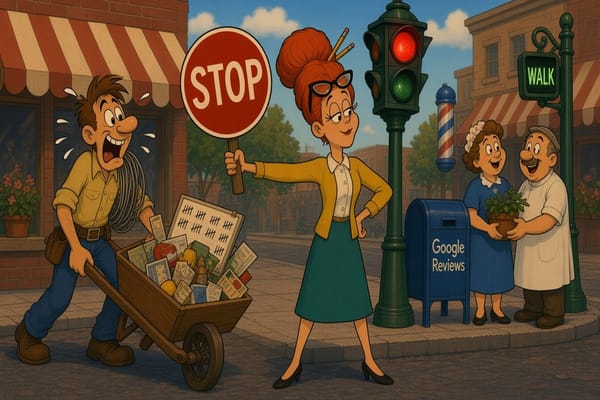
Your business has a wall of five-star reviews. Unfortunately, the wall appears to have stopped construction two summers ago.
Those old reviews still count. But someone booking a cleaner, choosing a salon, or finding an electrician wants to know what happens when they hire you now. An excellent job from years ago doesn't answer whether today's team turns up, explains the work, and leaves the place in decent shape.
The fix isn't a frantic review campaign. It's a small change to the end of every job or appointment: offer the review link while the experience is fresh, then give the customer space. Don't let the first invitation sit in an office queue until Thursday.
Old reviews prove history. Recent reviews show what's happening now.
A long review history is an asset, not something to replace. It shows you've served real customers over time. Fresh feedback adds something different: evidence of the experience people are getting lately.
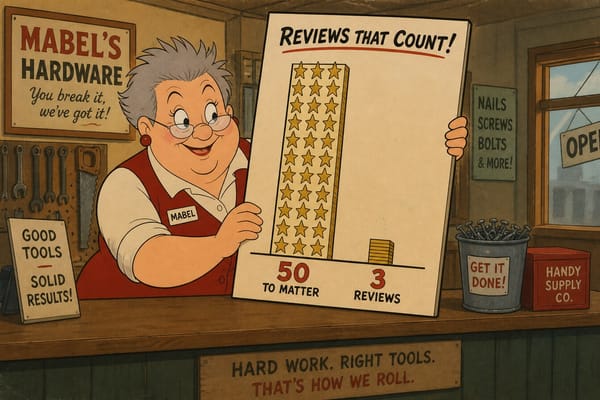
Picture two businesses with similar services and ratings. One has a huge total but nothing recent. The other has fewer reviews, with customers regularly describing completed visits. A prospective customer may find the second more reassuring. That's a buying decision, not a promise about which listing Google will rank first.
BrightLocal's 2026 Local Consumer Review Survey identifies recency as an important part of how consumers evaluate reviews. It's consumer research about reported preferences, not an experiment proving what Google's algorithm rewards.
Google's own local ranking guidance says results mainly depend on relevance, distance, and prominence, and that more reviews and positive ratings can help. It doesn't identify review recency as a separate, confirmed ranking factor or promise that newer reviews beat a higher count.
So keep the old proof. Stop relying on it to do all the work. If you're asking how many Google reviews do I need, remember that a total isn't a maintenance plan.
Move the first ask to the handoff
The practical advantage of asking at completion is context. You've just returned the keys, finished the walkthrough, or explained the aftercare. The customer knows who you are and what the link is for. Days later, your request has to reintroduce the whole experience between a delivery notification and an offer for printer toner.
That doesn't mean every customer will write a review immediately, or that there's a universal best minute backed by a conversion statistic. It's a sensible default: make the invitation part of closing the visit rather than an administrative task someone might remember later.
Use the moment when the service is actually complete:
- After the repair has been explained and the work area cleared.
- When the car keys are returned and the customer understands what was done.
- At the end of a haircut, cleaning visit, or completed appointment.
- After the final walkthrough of a larger project, rather than after every interim visit.
If nobody's there, a completion message with the link can do the same job. If the customer is rushing, distressed, or dealing with something urgent, don't force a little marketing ceremony. Make the link available in an appropriate follow-up instead.
Use one sentence. Then leave.
You don't need a speech about how much Google means to a small business. You need a clear invitation with no obligation attached.
“Thanks for choosing us. If you'd like to share your experience on Google, this card has the link. You can use it later—there's no obligation.”
Offer a small QR card or a direct link on their own device. Before staff leave, when appropriate, make sure the customer has a way to find it. That's the handoff. The customer doesn't owe you a scan, a rating, or an explanation.
Google recommends review links and QR codes as ways to remind customers. Test yours on a phone before printing a stack. It should reach the correct business's review destination, not send people hunting through your website.
Then step away. Don't watch them type, ask for a screenshot, or wait beside the door for five stars to appear. Nobody should need to review your business to get your employee out of their kitchen.
Google's Maps contribution policy prohibits pressure to review on the premises and requests for specific review content. Don't dictate the rating, wording, or staff names. The point is to make honest feedback easy, not stage-manage it.
Make follow-up a reminder, not the opening move
Email and text aren't the enemy. An invitation several days later isn't automatically wrong. It's just a shaky default when you already had a natural opportunity to offer the link at completion.
Some customers need time to see how the work holds up. Others won't open a link until they're sitting down that evening. Give them that freedom. Where you have permission to contact them, a gentle follow-up can help them find the invitation again.
“Thanks for choosing [Business] for your recent [service]. If you'd like to share your experience, here's our Google review link: [link]. No obligation, and no need to reply.”
Keep it recognizable and brief. Don't invent urgency or imply that someone's pay depends on the review. Honor opt-outs, avoid unnecessary personal details, and don't chase people who decline.
For recurring services, don't turn every weekly visit into another request. Keep enough context in your records to avoid repeatedly nudging the same person. A customer who already reviewed you doesn't need to become a subscription to your reminder department.
Build a completion habit, not a happy-customer filter
Set one neutral process for genuine completed experiences. Don't ask only the customers who complimented the team, or send a satisfaction survey that directs positive respondents to Google while diverting everyone else.
If you're asking is review gating allowed, the short answer is no: don't selectively solicit positive reviews. Don't attach discounts, prizes, or other rewards either.
Start small this week. Put the link into the completion checklist. Give staff the same optional invitation. Keep a simple record of whether an invitation was offered so the office doesn't duplicate it. Don't set staff review quotas or reward particular ratings.
If reminders keep slipping, a tool like More Good Reviews can help you maintain a regular review-request routine. The software supports the habit; it doesn't replace good service or the customer's choice.
The bottom line
Your old reviews aren't worthless. They're just not a substitute for current evidence that your business still delivers.
Offer an honest review invitation when the job, appointment, or visit is complete. Leave the link, give the customer privacy, and follow up gently where appropriate. Build that into normal work, and you have a sustainable way to keep earning fresh feedback—without turning the handoff into a hostage negotiation.